Quantum Club
Quantum Club is dedicated to exploring the exciting world of quantum science and technology, with a focus on computing, cryptography, and communication. The club creates opportunities for students to deepen their understanding of quantum principles while connecting classroom knowledge with practical applications in next-generation technologies.
By organizing talks, workshops, coding labs, and collaborative projects, the Quantum Club encourages students to build technical expertise, engage in research, and think critically about the future of technology. The club envisions nurturing a community of innovators and problem-solvers who will lead the way in the rapidly evolving quantum era.
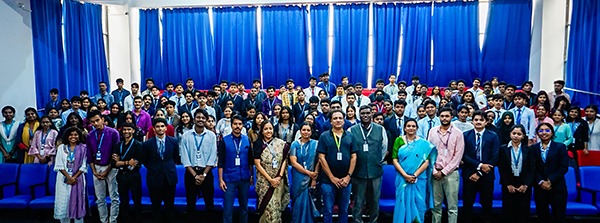
Quantum Leap–2026: Empowering the Next Generation of Quantum Thinkers (National Workshop)
Date: 23 January 2026
The Department of Computer Science, Kristu Jayanti (Deemed to be University), in association with the KJU Quantum Club, successfully organized a National Workshop titled “Quantum Leap–2026: Empowering the Next Generation of Quantum Thinkers” on 23 January 2026 at AL2 Lab, Admin Block.
The workshop was conducted by Mr. Raja Singh Yadav, Knowledge Associate, C-DAC, Bangalore, who delivered an engaging and informative session on the fundamentals and applications of quantum computing. A hands-on demonstration was conducted using the Qniverse platform (qniverse.in), where participants observed the execution of basic quantum circuits and gained exposure to real-time quantum simulations. This practical session helped bridge the gap between theoretical concepts and real-world implementation, making the learning experience more effective and interactive. The workshop was highly informative and inspired students to explore advanced learning in the field of quantum computing.
Expert Talk on Beyond Classical Limits with Quantum Computing
Date: 09 September 2025
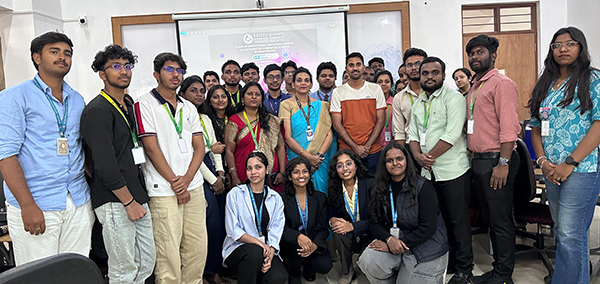
The Department of Computer Science, in collaboration with the Department of Physical Sciences and the KJU Quantum Club, organized an expert talk on Quantum Computing. The session aimed to introduce students to the emerging field of quantum technology and its potential to overcome the limitations of classical computing.
The resource person for the event was Mr. Dhruvaraj S, OpenBMC Developer, IBM Bengaluru, India. He provided valuable insights into the fundamentals of quantum computing, highlighting how it differs from classical computing and explaining its applications.
During the talk, students were introduced to key concepts of quantum mechanics applied to computing, such as quantum bits, superposition, entanglement, and quantum circuits. Mr. Dhruvaraj also encouraged students to explore practical aspects of quantum computing by working with basic quantum circuits.
The session proved to be highly insightful and informative, helping students gain a foundational understanding of this rapidly developing technology. The interactive nature of the session motivated students to take an active interest in exploring quantum computing further.
Overall, the orientation session was a great success, leaving students inspired to learn more about the future possibilities in the field of quantum technologies.